top of page

EAST ASIAN STUDIES
Culture Projects 2014
KOREAN LANGUAGE: EVOLUTION AND MODERN DAY
Anient Roots: Korean is one of the world's oldest living languages, yet the details of its origin are obscure. However, many nineteenth Century Western scholars propose a number of theories that link the Korean language with Ural-Altaic, Japanese, Chinese, Tibetan, Dravidian Ainu, Indo-European and other languages. Linguistically, Korean is unrelated to Chinese and is similar to, but distinct from Japanese. During the 7th Century, when the kingdom of Silla conquered the kingdoms of Paekche in southwest Korea and Koguryo in the north, the Silla dialect became the dominant language on the peninsula. Then, following the rise of the Koryo Dynasty during the 10th Century, the national capitol was relocated to the city of Kaesong, and thus the Kaesong dialect emerged as the national language standard. The Choson Dynasty, founded at the end of the 14th Century, had its capital moved to Seoul. The new capital's geographic proximity to Kaesong however, did not lead to any significant changes in the language. In the modern day, there are a number of regional dialects within Korea, defined mostly by the variations in stress placed on certain syllables and words from region to region.
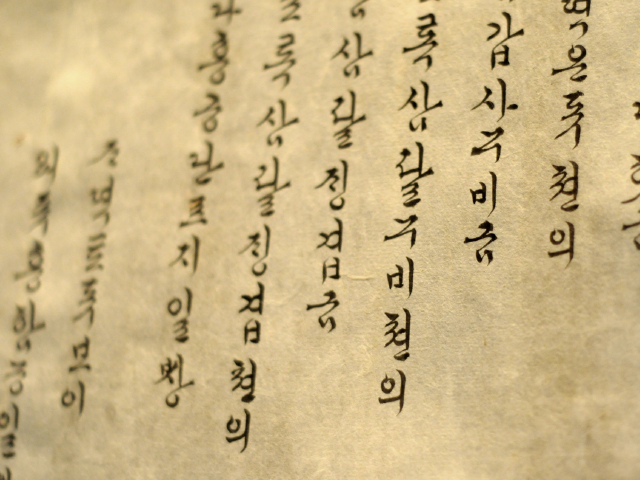
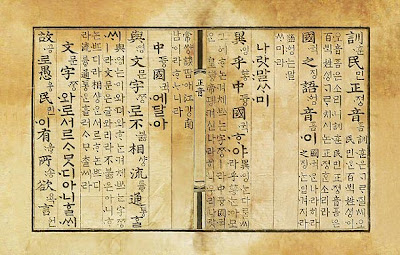
Writing System: The oldest writing system in Korea is Han'ja, a Korean adaptation of Chinese pictographs for the language of government and business. Although Han'ja evolved as a consequence of centuries of Chinese rule and cultural influence in Korea, it is not entirely Chinese. However, during the Yi Dynasty, certain methods of simplification were taken. During this period, only the upper classes were educated and able to read, write, and publish in the standard form of Chinese. To combat this issue of illiteracy amoung the lower classes, King Sejong devised a method of writing that would be easier for the Korean peasantry to learn. This was unheard of in a time when Korea's literati spent most of their time trying to secure and enhance their own status. In 1440, he commissioned scholars of the Royal Academy to create a unique, simple, easily learnable phonetic alphabet. A simple alphabet of 28 characters (17 consonants and 11 vowels) emerged from a careful study of the shape or form of the speech organs (i.e. the mouth, the tongue, the throat) and the shape they take during speaking. In 1446, the Royal Academy scholars presented Sejong with a second, much longer thesis that set down the principles behind the invention of the alphabet and its usage. This mirrors the current movements in China to simplify the language to promote literacy.



bottom of page